14.01.2020 Tuesday, 15:00 – 16:00
First lecture for Industrial Economics. The lecturer seems fun. She finds a lot of personal examples about how market failures have failed her. She seems to repeat the same thing a few times, which is honestly quite useful in lectures. Did not make notes before the class started.
This class seems very “traditionally” economics, as in the focus on firms. Most of my specialisations in stage 3 moved away from that, so it might be nice to refocus.
Notes
Introduction to the module, admin notes
This is the second year this module is taught at this university by her, but she taught this subject in various other universities.
Some points she included to be motivational I suppose:
Students who learn with the mindset: “Work hard to learn more and get smarter.” Get higher marks and have better test scores.
Dweck, C. Mindset: The New Psychology of Succsess (Random House, 2006).
This reminds me of this thing we read in the psychology textbook for the IB, about how people who think intelligence is a fixed trait tend to not perform as well, while people who believe intelligence is a skill you nurture and develop perform better on average. It is kind of evident that this link exists I suppose, but sometimes it can be beneficial to really point this out.
Focus on your improvement.
Of course.
Then some notes on how you are not here to learn to imitate well, but to learn the method and how to apply it to other situations. Which is why they will not give us the answers to past paper questions.
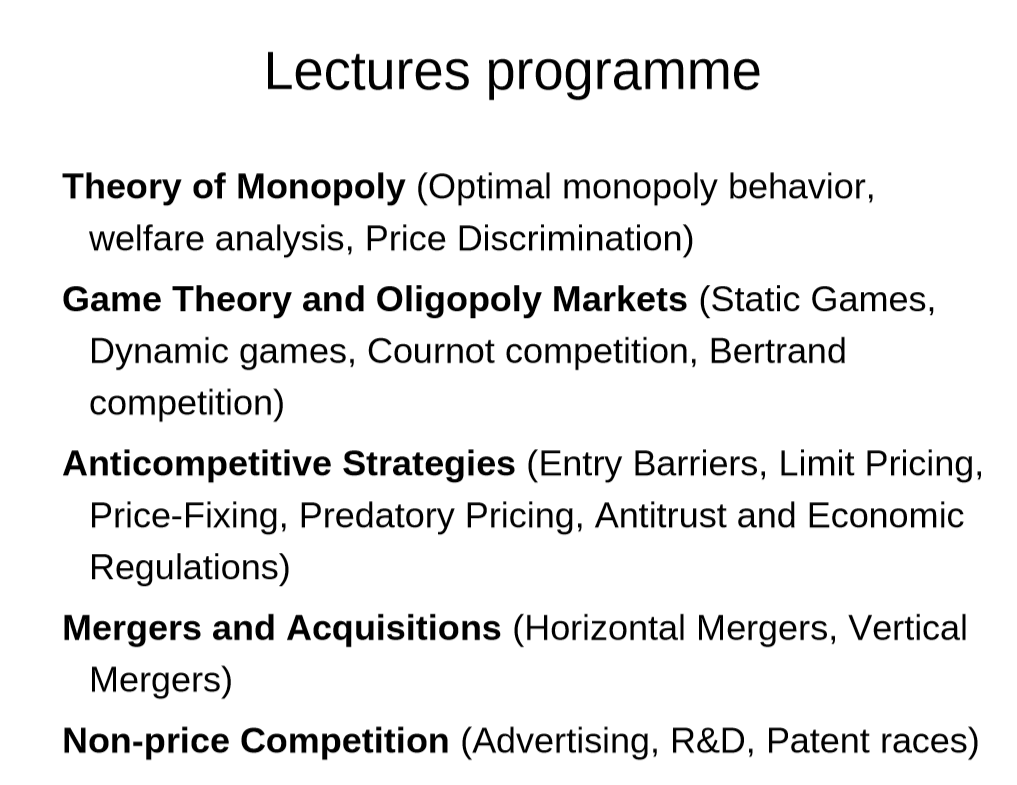
The point of this module: Industrial Economics is really just an application of microeconomic theory. Specifically on the analysis of firms, markets and industries where competition is less than perfect. – Because perfect competition is a theoretical concept and it does not exist in the real world. Therefore these skills may be transferable to other applications of microeconomic theory.
The overall aim is to provide a framework for explaining firm behaviour, assessing the welfare consequences of this behaviour and discussion policy prescriptions.
This module will be of interest to people who want to pursue careers as firm managers, consultants, and policy makers. As a policy maker you need to assess the competitiveness of an industry and make decisions based on whether you wish to increase or decrease it (wanting to decrease competitiveness is rare). As a consultant you may need to advise management about the best strategic behaviour in a specific market setting. As a manager you may want to undertake that strategic behaviour.
It is relevant to the study of other disciplines in economics, like Macroeconomics or International Economics, as the behaviour of firms affects the performance of the economy both domestically and internationally.
Learning outcomes:
- Ability to explain how firms’ decisions regarding price, advertising and R&D etc. can be modelled and evaluate the impact of those decisions on the structure and performance of markets.
- Understand and apply the basic concepts of game theory to the analysis of firm’s strategic behaviour.
- Identify the implications of the theory for the design and implementation of industrial policy.
- Ability to follow the analysis of economic problems, construct your own economic arguments and offer critical comments on the arguments of others.
The assessment for this module consists of two components. Coursework (20%) and the final exam (80%).
The coursework is divided over an ICT in week 8? (8%) due Tuesday 03 March 2020 week 20, participation in seminars when covering the problem sets (4%), and a 1500 word essay (8%) due 30 March 2020 (week 24). The essay questions are already available on the module outline.
I have looked at the module outline for this class. It is super extensive and detailed. I should refer back to it often, it should be very helpful.
 Home
Home 