14/01/2020 Tuesday 13:00-14:00
Information about the upcoming assessment will be posted sometime next week. Students will have about 2 weeks (1,5 weeks really) to do the assignment. Each assignment should be about 1000 words. All problems will be similar to those done in workshops. [So go to the workshop. pls]
Started with a continuation of lecture slides 1 as we did not fully finish this in the previous lecture.
Notes
Lecture 1 – Introduction
Continuation on slide [21], on seeing the environment as a waste sink.
The physical assimilative (read absorbing) capacity of the environment can be categorized under land, water, and atmosphere. It is determined by physical factors eg climate, rainfall, wind patterns and geographical location. We can distinguish between degradable waste and cumulative waste. For cumulative waste we have to consider the importance of the threshold of the environment as a waste sink.
If we consider cumulative waste and there is a threshold, we can avoid reaching this threshold using economic instruments.
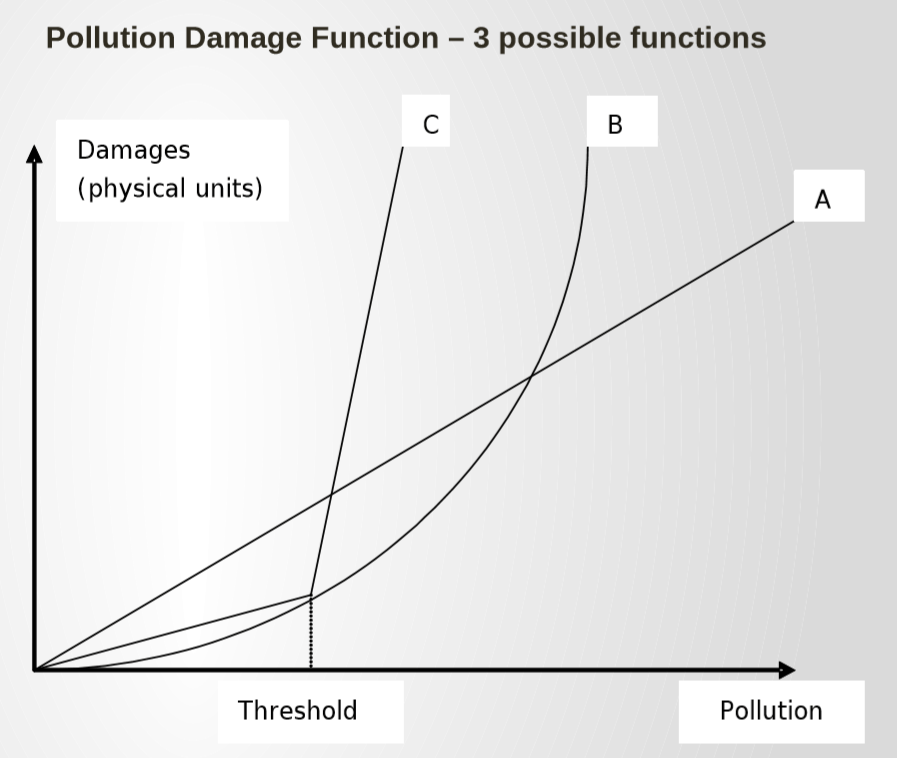
This diagram illustrates 3 possible functions of pollution damage. Damage function A is linear. Damage function B is exponential. Damage function C is a function with a kink, at which the threshold is. The point as which the kink is, is the point at which the marginal damages caused by pollution become larger. So after the threshold, the cost in damage caused by pollution becomes higher than the cost in damage caused by pollution before the threshold.
An example is the level of oxygen in water (BOD). If it falls below a particular level due to water pollution it becomes extremely dangerous to aquatic species, like a threshold.
We can describe the assimilative waste capacity of the environment in a mathematical way:
Stock of degradable pollutant (S) at time t is given by S = F – A
Stock of cumulative pollutant (S) at time t* is given by S = ΣF
F represents the positive flow (of pollution) in a year. A represents the amount of pollution that is assimilated by the environment in a year.
We might need to take efforts in environmental management to prevent further pollution as to avoid the threshold.
Recycling
The 3R’s of recycling are Reduce, Reuse, Recycle. After this, the final option is to dispose. There are limits to Reusing and Recycling, partly due to the laws of thermodynamics, but also the costs associated with re-use and recycle.
– End of lecture slides 1 –
 Home
Home 