Lecture 1 – Introduction
Overview of this lecture
- Overview of links between the economy and the environment
- Explain the significance of this discipline
- Examine links between the economy and the environment
- Identify the 4 main areas of focus in this class
Economy-Environment Relationship
“….the economy is not separate from the environment in which we live. There is an interdependence both because the way we manage the economy impacts on the environment, and because environmental quality on the performance of the economy.”
(Pearce et al, 1989, Blueprint for a Green Economy)
“1. Our society, economy and individual wellbeing depends upon a healthy natural environment. It underpins everything we collectively produce and consume. We rely on it for food, energy, minerals, clean air and clean water as well as countless other inputs into the production process.”
(State of Natural Capital Report, NCC, April 2013, page 10).
Lecturer mentioned how we take these essential things for granted. The point about food made me think of the topic of agriculture in the Development Economics module, and how for most of history most people’s lives were heavily intertwined with agriculture and it is only in modern history that we don’t as much.
Many examples of the Economy-Environment relationship interact or are interdependent.
- Agriculture – pretty Landscape, soil erosion, water pollution, greenhouse gasses, etc.
- Tourism – competing land use, congestion, pollution (local and global), etc.
- Leisure – competing land use, congestion, pollution (air, water, noise), etc.
Model of Economy-Environment
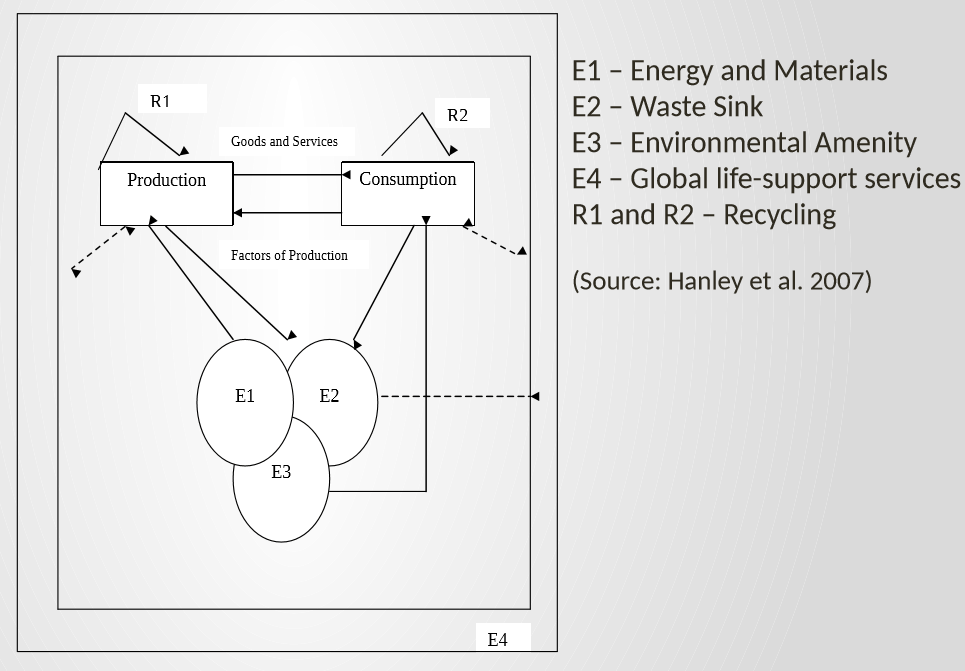
Vocabulary: Amenity – a desirable or useful feature or facility of a building or a place. The pleasantness or attractiveness of a place.
So, in this module we are taking into account the environmental externalities of markets that we normally ignore, or at least don’t really measure, in standard economic theory. An example that was given were base camps for Mount Everest in Nepal. Here the environment creates tourism, which increases Nepal’s national income. The cost might be congestion and potentially the diminishing value of the environment due to loss of quality of the environment after every human activity and pollution.
Some examples of topics within environmental economics:
- Biodiversity – example given was how he flew to Seychelles to give a monetary valuation for a rare bird species found on only one of the islands to determine the cost and benefits of potentially migrating the bird to other islands in an attempt to improve its population and the biodiversity on other islands.
- Greenhouse gases – something about being able to harness greenhouse gasses to create other products that can contribute to society. So taking environmental waste and finding a way to create monetary value from it?
- Tourism – how high quality environments stimulate tourism and national economies.
- Recreation – some environments can create potential recreational activities. Example given here was hiking or mountaineering. I was personally thinking about surfing.
- Gulf of Mexico Oil Spill – about how environmental economists had to estimate the monetary value lost after the oil spill, like through tourism, and how to figure out who should be compensated and how much to sue the oil company.
- Acid rain – I can’t really remember much about this, I must have lost my concentration.
Some statistics regarding the valuation of the environment. The value of natural resources extracted for use in the UK economy in 2007 is 41 bn GBP. Global estimated degradation of the planet’s ecosystem costing 50 bn EUR per annum, which could rise to the equivalent of 7% of the global GDP by 2050. Air pollution reduces life expectancy of the UK population by an average of 6 months, costing 15 bn GBP per annum. Living within 500m of accessible green space correlates with 24% increased likelihood to meet recommended levels of physical activity. Reducing sedentary population by just 1% can reduce UK morbidity/mortality (what is the difference?) valued at 1.44 bn GBP.
Vocabulary: Sedentary – 1. (of a person) tending to spend much time seated; somewhat inactive. 2. (of work or a way of life) characterized by much sitting and little physical exercise. 3. (of a position) sitting; seated. 4. Inhabiting the same locality throughout life; not migratory or nomadic.
The point of these stats is to show the usefulness of giving monetary value to things that do not naturally have a market value. This can be used to determine the costs and benefits of potential funding of the environment. It makes it more tangible and can be used to motivate policy.
Typical characterisation of the economy in many textbooks is to divide it into two sectors: production and consumption. In this class, we consider the use of the environment into 3 main ways:
- As a supplier of natural resource inputs
- As a supplier of environmental or amenity goods
- As a waste sink – this is the first topic we will look at in detail in this class
1. As a supplier of natural resource inputs
Some examples may be land, water and stocks of raw materials. In this discipline we differentiate between renewable (trees) and non-renewable (crude oil) resources. The distinction is important as it influences the way the resource will be managed. The use of the environment under this category is the creation of goods and services and other inputs. This process also generates waste.
2. As a supplier of environmental or amenity goods
Economic benefits (ie increased utility) can be derived from the “consumption” of environmental goods. Some examples of the qualities of the environment that can be consumed are:
- Beautiful landscapes (Tuscany?)
- Recreational opportunities
- Climate regulation – trees and sea can absorb some carbon dioxide or other wastes (to a certain extent)
- Enjoyment (use and non-use) from biodiversity
However, there is a market failure. Consumers are unable to fully express their preferences regarding the environment. We are unable to buy a unit of clean air or select between various qualities of air. As air is “free”, we overconsume it. An important example of a market failure in this context is global warming. The potential solution is to create a ‘market’ in air pollution rights (such an economist’s solution). Examples of these are:
- Transferrable discharge permits
- Kyoto
- EU ETS
- Paris Accord
Such a market would never naturally occur, and in order for it to exist it needs to be designed. A lot of consideration needs to go into the design of such a market, as the environment affects many industries and on an international level. Creating a monopsony is not the answer.
“The natural world, its biodiversity and its constituent ecosystems are critically important to our well-being and economic prosperity, but are consistently undervalued in conventional economic analyses and decision-making. Ecosystems and the services they deliver underpin our very existence. We depend on them to produce our food, regulate water supplies and climate, and breakdown waste products. We also value them in less obvious ways: contact with nature gives pleasure, provides recreation, and is known to have a positive impact on long-term health and happiness.”
UK NEA (2011)
The key word in this quote is undervalued. Valuation is what drives policy agendas.
3. As a waste sink
We should consider the environment’s capacity to assimilate waste products from production and consumption. This capacity is fixed. Ideally, we would want to convert waste into harmless or ecologically useful products. The example given was the growth of algae with greenhouse gasses as input in order to create Quorn, the vegetarian meat replacement. Moving on, the environment is impacted by the intentional release of chemicals, like pesticides, wood preservatives, paints and lubricants. We should consider what happens when we reach the limits of the environment’s capacity to absorb these wastes.
Human activity has impacted the composition of chemicals in the atmosphere. The concentration of carbon dioxide have risen by over 30% since the pre-industrial period (1750s). Other significant increases have been observed in methane and nitrous oxide concentrations. Serious concerns have been raised regarding the increasing concentrations in the atmosphere and the associated climate change. (Stern, 2007).
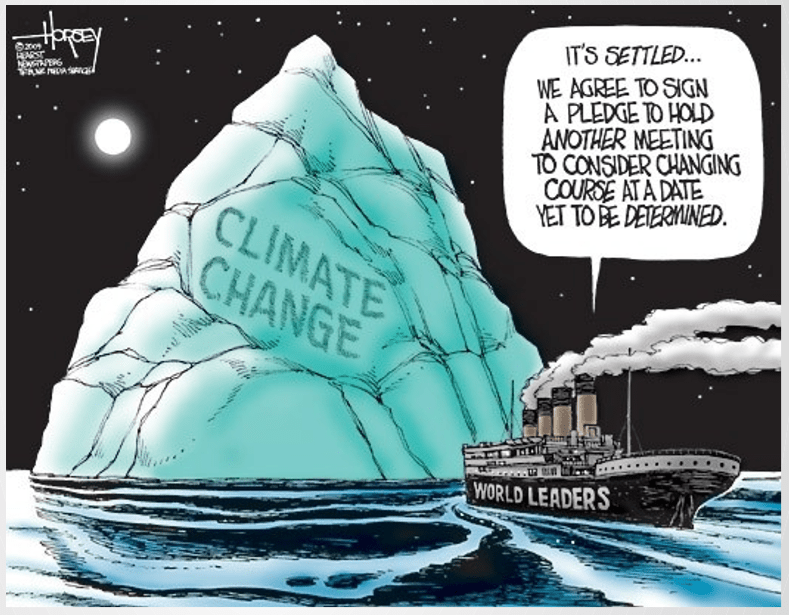
Some commentary about how world leaders have not been able to come to an agreement and the talk has been postponed for a year. Next year will be held in London.
The physical assimilative (read absorbing) capacity of the environment can be categorized under land, water, and atmosphere. It is determined by physical factors eg climate, rainfall, wind patterns and geographical location. We can distinguish between degradable waste and cumulative waste. For cumulative waste we have to consider the importance of the threshold of the environment as a waste sink.
The rest of the lecture will be continued at another date, so that’s it for my notes for this post.
 Home
Home 